
Protocol for a Randomized Controlled Trial Enhanced with Single-Case Experimental Design
Updated: Aug 2, 2023
Authors: Simons, Harrison, O'Brien, Heirich, Loecher, Boothroyd, Vlaeyen, Wicksell, Schofield, Hood, Orendurff, Chan & Lyons (2019)
This paper reports the protocol for a study evaluating the effectiveness of a graded exposure treatment ("GET Living") for adolescents affected by chronic pain. The study uses a novel design - a single-case experimental design embedded within a randomised controlled trial. The strengths are the use of randomisation in the length of the baseline pre-treatment, as well as the random allocation to treatment and control condition. Daily diaries collecting outcome data allow the analysis to explore individual effects, while multi-level hierarchical models are used to understand the effect of the treatment on average. The novel design of the study will provide an important contribution to the field by showing how idiographic and nomothetic approaches can be combined and complement one another well.
Click here to read the full article
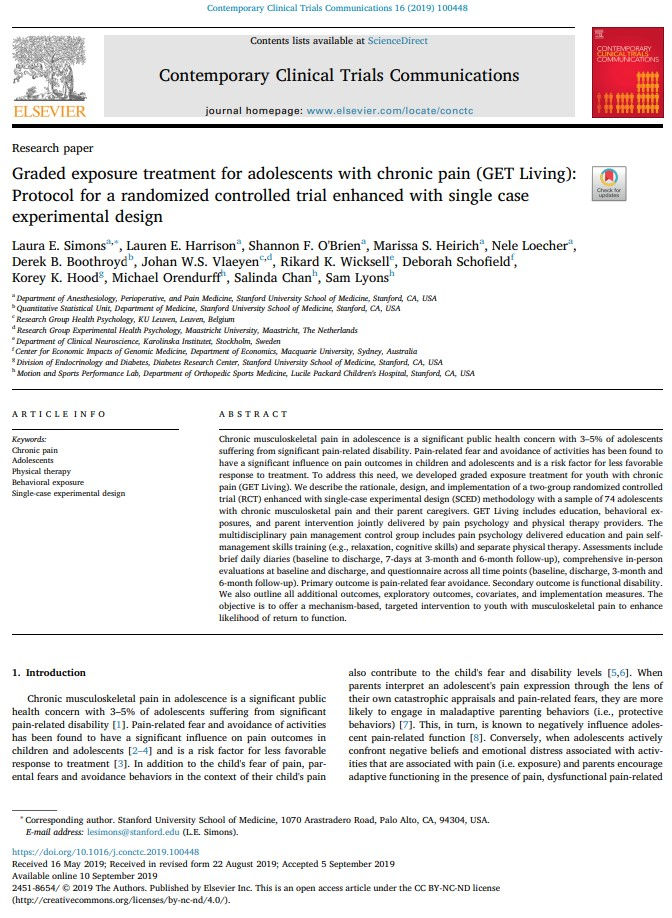
Full reference: Simons, L. E., Harrison, L. E., O'Brien, S. F., Heirich, M. S., Loecher, N., Boothroyd, D. B., ... & Lyons, S. (2019). Graded exposure treatment for adolescents with chronic pain (get living): protocol for a randomized controlled trial enhanced with single case experimental design. Contemporary Clinical Trials Communications, 16, 100448.


Comments